








BENTLEY
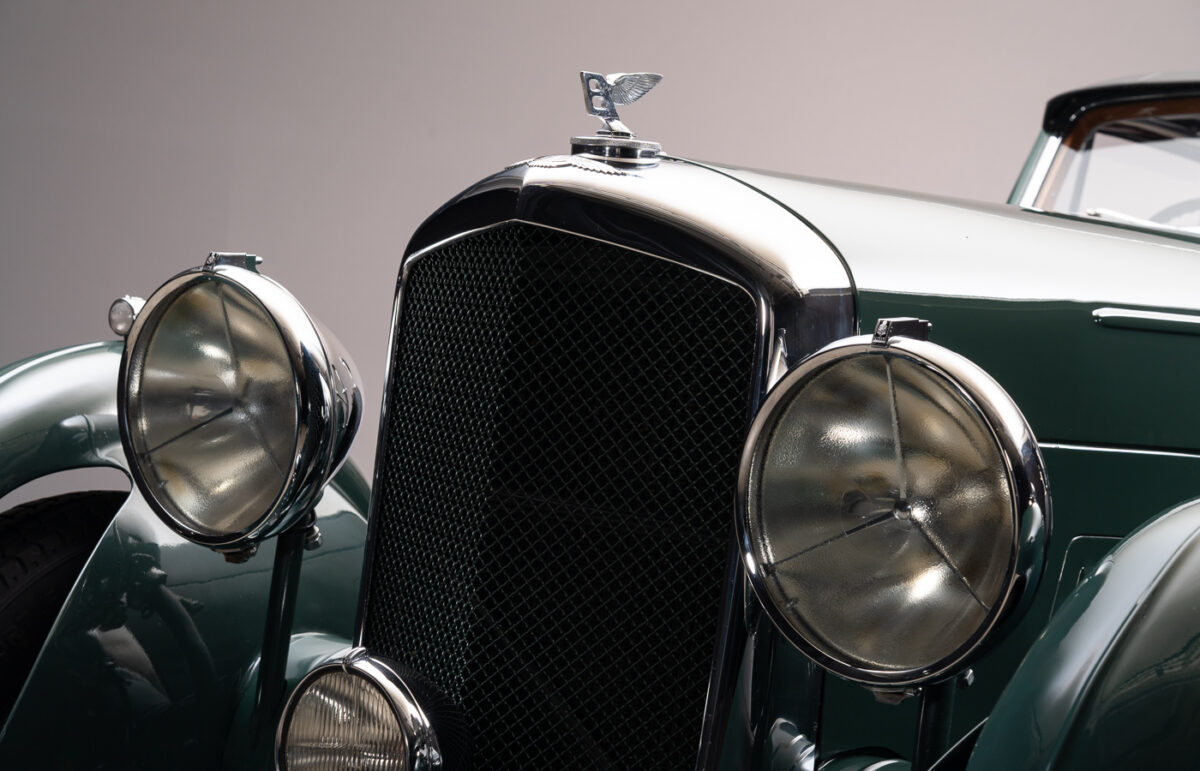
Speed Six Blue Train “Recreation”
- One-off built on a Bentley MK VI chassis
- Extensively documented
- German road registration
- Rare opportunity for Bentley enthusiasts
 Request
 More
Thiesen Hamburg GmbH
Timm Meinrenken
M +49 (0) 172 / 540 15 60
Justus Baehr
M +49 (0) 173 / 798 32 89
Mike Tetzlaff
M +49 (0) 172 / 955 29 89
OfficeP +49 (0) 40 / 450 343 – 0
sales@thiesen-automobile.com


Equipment:
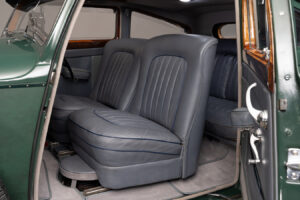
- Large folding roof
- Wire wheels 18 inch
- Central lubrication
- Walnut wood
- Long rear-axle ratio
- Synchromesh gearbox (2nd – 4th gear)
Description:
Few cars embody the glamour, speed and power of the pre-war Bentley era better than the “Blue Train” Bentley Speed Six. In this car, Bentley Boy Woolf Barnato raced and beat the Blue Train north from the Côte d’Azur to Calais. Woolf Barnato – heir to a vast fortune from the diamond mines of Kimberley in South Africa – was the ultimate “Bentley Boy”. A brilliant sportsman, playboy and generous host, he became chairman of Bentley Motors in 1926. W.O. Bentley regarded him as the best driver of the team, not least because of his successes for Bentley at “Le Mans” with 3 starts and 3 wins. In March 1930, Barnato was at a dinner party aboard a yacht near Cannes when the race against the “Blue Train” came up. Both “Rover” and “Alvis” had recently beaten the train from St. Raphael to Calais. Barnato was unimpressed and called the feat “no great shakes”. He bet £200 that at the wheel of his Speed Six he could beat the train to Calais with ease. The next day at 5:45 pm, as the “Blue Train” left Cannes station, the race began. Over the 185 miles from Cannes to Lyon, Barnato and his co-driver Dale Bourne were caught out by heavy rain. Around 4 am, near Auxerre, the team lost some time searching for an agreed refuelling rendezvous.
Despite this setback, thick fog near Paris and a puncture that used up their only spare tyre, Barnato and Bourne finally reached Calais at 10:30 am. They had covered over 570 miles at an average speed of 43.43 mph – an impressive result on the dusty, rough roads of the time. His performance was so exceptional that a re-run by Car Magazine in 2015 in a Continental GT3-R only just beat Barnato’s 1930 average speed.
About the vehicle:
The vehicle presented here was completely rebuilt on the basis of a 1950 Bentley MK 6. It was modeled after the Bentley Speed Six, bodied by Gurney & Nutting as a one-off for Woolf Barnato. The work was carried out to a high standard of originality and craftsmanship. The work was carried out by German experts. The current owner completed the car about six years ago and has since covered around 20,000 kilometres at international events. The car has thus proven itself over several years, including on longer journeys. With its comparatively powerful 4.25-litre engine and long rear-axle ratio, the car is very pleasant to drive and reaches a comparatively high top speed. This “Blue Train” recreation combines the impressive appearance of its historic model with careful craftsmanship and convincing driving characteristics. Extensive documentation is available. The car is registered in Germany. Acquiring the vehicle presented here is a rare opportunity for Bentley enthusiasts!